
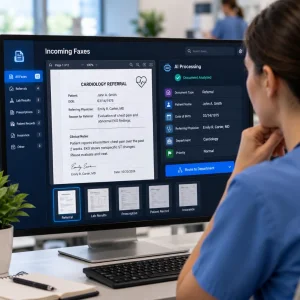
 Artificial intelligence is changing how healthcare organizations manage patient information, but one of its more interesting applications involves a technology that’s been around for decades: fax.
Hospitals, clinics, pharmacies, and medical practices still exchange enormous amounts of information through fax. Referrals, lab results, prescriptions, insurance documents, and patient records often arrive as scanned pages that someone must manually review, organize, and route.
What if artificial intelligence could handle much of that work automatically?
AI-powered document processing is making that possible. However, when patient information is involved, automation also introduces important questions about privacy, security, accuracy, and HIPAA compliance.
How Does AI Read a Medical Fax?
Traditional faxing delivers an image of a document. Whether that document arrives on paper or through a cloud fax service, the information it contains isn’t necessarily searchable or understood by a computer.
Optical Character Recognition (OCR) technology can convert scanned text into machine-readable information. Modern AI systems can take that process further by interpreting the document’s contents.
For example, an AI-powered system could potentially:
- Identify document types: Determine whether an incoming fax contains a referral, lab report, prescription, or insurance request.
- Extract patient information: Recognize names, dates of birth, medical record numbers, and other relevant details.
- Organize incoming documents: Categorize faxes and prepare them for filing in an electronic health record (EHR).
- Route documents: Direct incoming information to the appropriate department or staff member based on predefined rules.
Instead of manually reviewing every incoming fax, healthcare staff could concentrate on documents requiring additional attention.
Why Healthcare Organizations Are Interested
Medical offices can receive dozens or even hundreds of faxes daily. Processing them takes time, especially when employees must identify patients, enter information into multiple systems, and forward documents to the correct departments.
AI-assisted processing could reduce this administrative workload while helping organizations handle incoming information more efficiently.
For example, a cardiology referral arriving by fax could be identified, matched to an existing patient record, and placed into a review queue without someone manually entering every detail.
The potential benefits include faster processing, fewer repetitive tasks, improved document organization, and reduced delays in getting information to healthcare professionals.
However, automation is only useful when the information it produces is reliable.
Where HIPAA Comes Into the Picture
The biggest consideration isn’t whether AI can read medical documents. It’s what happens to protected health information (PHI) during that process.
Under HIPAA, healthcare organizations and their business associates must implement appropriate safeguards to protect patient information.
When an AI processing service creates, receives, maintains, or transmits PHI on behalf of a healthcare organization, it will generally be considered a business associate. That typically requires a Business Associate Agreement (BAA) and compliance with applicable HIPAA requirements.
This becomes particularly important when documents are sent to outside cloud platforms for processing.
A healthcare organization might receive a fax through a properly secured service but inadvertently expose patient information by uploading that document to an AI platform that isn’t authorized or appropriately configured to handle PHI.
Before introducing AI into medical fax workflows, organizations should evaluate:
- Business Associate Agreements: Ensure applicable agreements cover third-party AI providers and relevant subcontractors.
- Data security: Protect information during transmission, processing, and storage.
- Access controls: Limit patient information to authorized users and systems.
- Data retention: Understand whether AI providers store documents, extracted text, or processing logs.
- Auditability: Maintain appropriate records of how documents are accessed and processed.
Using AI doesn’t automatically violate HIPAA. But it doesn’t automatically satisfy HIPAA requirements either.
What Happens When AI Gets Something Wrong?
One of the less-discussed risks of AI document processing is accuracy.
Medical faxes aren’t always perfectly readable. Documents may contain handwritten notes, poor-quality scans, unusual formatting, or incomplete information.
An AI system might incorrectly interpret a medication dosage, confuse two patients with similar names, or send an urgent referral to the wrong department.
Unlike traditional OCR, which may produce obviously garbled text, more sophisticated AI systems can sometimes generate convincing but incorrect interpretations.
That’s why human verification remains important, particularly when automated information could influence patient care.
Healthcare organizations should establish procedures for handling uncertain results, verifying patient matches, and reviewing clinically significant information before acting on it.
AI should help employees process information more effectively, not eliminate the safeguards that protect patients.
Will AI Eventually Replace Medical Faxing?
Interestingly, AI may make medical faxing more useful rather than eliminate it.
Healthcare organizations rely on different electronic health record systems, and exchanging information between them isn’t always seamless. Fax continues to provide a familiar method for communicating across organizations that don’t share compatible technology.
AI-powered processing could bridge that gap by converting incoming fax documents into structured information that modern healthcare systems can use.
Instead of replacing fax, AI could transform what happens after a fax arrives.
The Bottom Line
Artificial intelligence offers significant potential to improve how healthcare organizations process incoming medical documents. Faster sorting, automated data extraction, and intelligent routing could save time and reduce administrative work.
But healthcare organizations must balance those efficiencies against the responsibility to protect patient information.
The goal shouldn’t be to remove people from the process entirely. It should be to use AI to handle repetitive tasks while keeping appropriate security controls, human oversight, and patient privacy firmly in place.